by
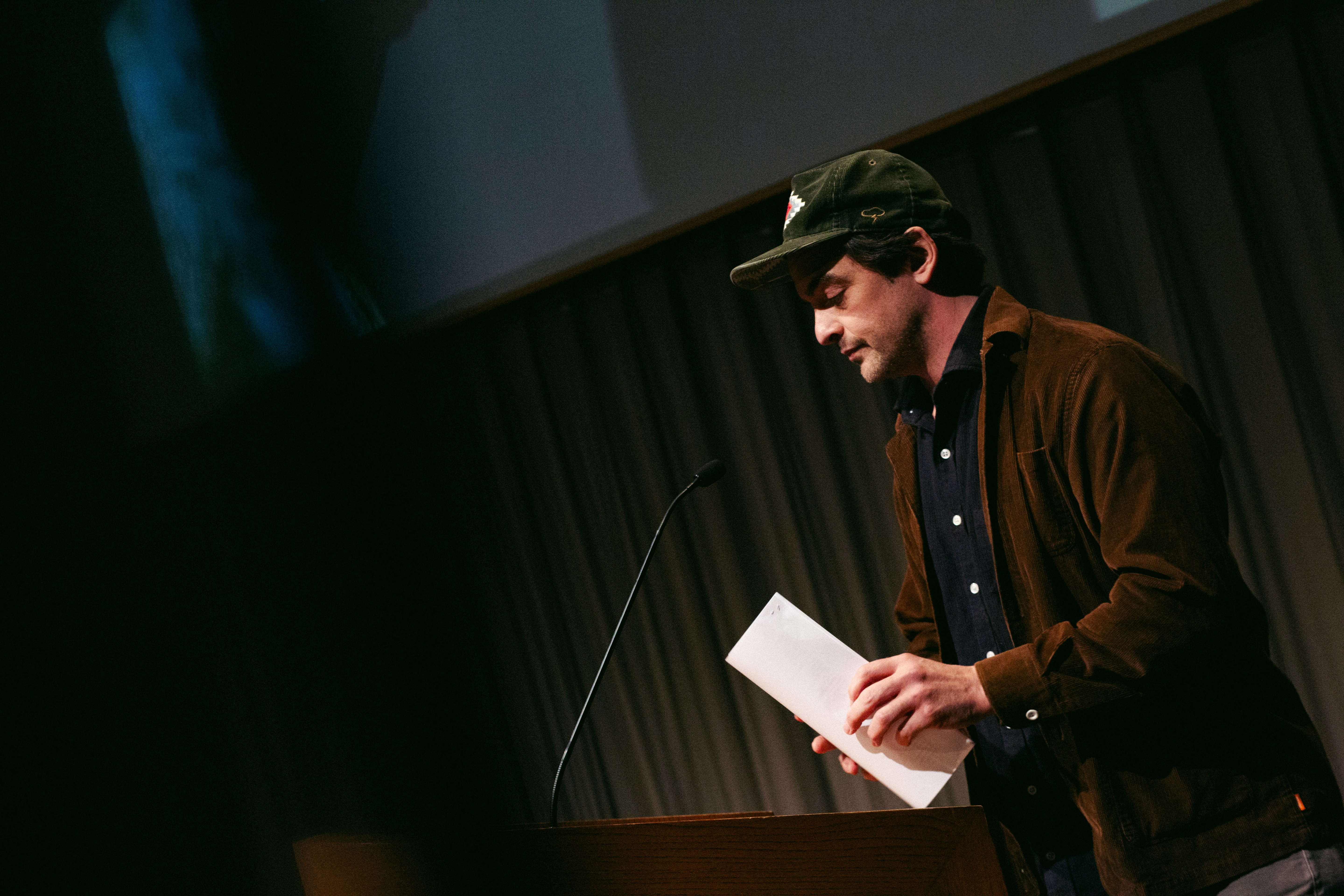
“I’m not a boxer or a fighter of any kind. I’m a writer,” says journalist Kelefa Sanneh, “Like many writers, I’m interested, or even obsessed, with boxing. There’s so many of us that we should have our own division. I think we should be known as paperweights.”
The long-standing fascination that artists — both performers and those who write material for them — have with boxing ties back the sport’s role in ancient human life. It speaks to the power of ritual, endurance, spectacle, and the raw theater of the human body under pressure.
Consider “The Boxer” by Italian poet Gabriele Tinti, selected by Vincent Piazza to open the “Boxing” panel at GAME TIME: Session 1 — the inaugural GAME TIME conference, held at Pérez Art Museum Miami on March 19th and 20th. The poem shares its name with a more than two thousand-year-old, larger-than-life bronze statue.
Tinti’s meditations on inner dialogue and physical suffering, though fictional, provide an undeniable mirror to living, breathing performances. The psychological and physical tensions that unfold in the ring continue to draw artists and actors like Piazza, who serves as executive producer of On The Line, toward boxing not just as sport, but as a subject, metaphor, and stage.
These dynamics surfaced again when Kelefa Sanneh asked On the Line director Francesco Saviano what is so amazing about boxing, and what is so awful about it. Saviano is quick to acknowledge the sport’s brutal and punishing nature, but offers a counterweight through author Sebastian Junger: “People have this need to fight one another in some way, shape or form, and the safe space of the boxing ring is where they feel they can do that.”
While On the Line unfolds as a real documentary shot over the course of ten years, the panelists inevitably drew comparisons to the fictional Rocky franchise. Boxing aficionados will claim that they aren’t interested in watching actors pretend to fight, but Sanneh points out that despite the mega franchise quality of the film, “the damage in Rocky is really front and center… it’s much less triumphant.” And ahead of Rising Up: Rocky and the Making of Monuments, a show he guest curated at the Philadelphia Museum of Art, Paul Farber adds that his enduring interest in Rocky stems from its ability to “[blur] art and life.”
Farber notes that “four million people visit the Rocky statue every year,” a scale of attention that underscores its multifaceted resonance. In Rising Up, he brings that mythology into the gallery, relocating the statue from its outdoor pedestal into the museum space and inviting visitors to take a closer look at both the icon itself and the process behind it. Across from the sculpture, contact sheets reveal the range of poses Sylvester Stallone worked through before arriving at the now-signature arms-raised stance.
To raise one’s fists in that triumphant pose is to step into a shared visual language, like putting a fist under your chin to emulate Rodin’s The Thinker pose. In the movie, audiences are not instantly introduced to this signature pose; they actually have to watch through several training montages before it’s introduced. As the ultimate underdog story, Farber proposes that Rocky’s “pose of triumph is one of making it, going the distance… like the effort to train, to get to the end of the fight, was the victory.”
During the panel, Farber draws a connection between this idea and Joyce Carol Oates’s On Boxing, which was also selected for a live reading by Alexandra Cunningham Cameron. He interprets Oates’ work as a reminder that “no matter who you’re fighting, you’re fighting yourself and your own limits.”
Oates’ writing returns again and again to the tension between triumph and failure within the self. In a 1987 New York Times review of On Boxing, that tension surfaces in a different register for the writer, who seems to care about boxing as a sport: “One of the remarkable things about boxing today is the lack of aggression in so many boxers… I’ve seen dozens of fights in which one of the contestants seems reluctant to throw a punch, even in self-defense.” The observation reframes the sport not as constant violence, but as an internal battle as much as a physical one.
Even after following a group of fighters over the course of a decade, On the Line director Francesco Saviano describes boxing as an ongoing dialogue. “I’m still trying to wrap my head around what boxing is and all the intricacies around it, the business side, the personal side,” he says. “With Vincent’s poem and the writing that Alexandra read, this is something people have been analyzing for thousands of years.”
These conversations continue in the work of artists operating across disciplines today. Within the GAME TIME network, dialogues around boxing—positioning the ring not as a closed arena but as an evolving stage—are put into practice. Paul Farber’s Rising Up: Rocky and the Making of Monuments is now on view at the Philadelphia Museum of Art from April 25 through August 2, 2026.
Tonight, April 27, GAME TIME will host a VIP screening of On the Line (RSVP HERE) at Bronx Legends Academy, marking the film’s New York premiere. Presented as the inaugural edition of GAME TIME: TAPE STUDY, a new series dedicated to the intersection of art and sport through moving image, the screening reframes the fight not as spectacle alone, but as an ongoing archive of lived experiences.
What emerges is less a conclusion than a continuation. Boxing, in this context, is never just a sport. It is a framework for thinking through discipline, spectacle, vulnerability, and control. The “paperweights” Kelefa Sanneh described exist both outside the ring and within it. The fight does not end with the final bell. It changes form, circulating through language, images, gestures, and the works still to come.